How to Build a Walking Route Map for a Day in a New City

One day in a city you have never walked is a small puzzle. You have a list of things you want to see, a hotel on one side of town, and a suspicion that the list is too long. Most people solve it by setting off early and hoping. A better approach takes fifteen minutes the night before: draw the day on a map, with distances and stops in order, and give yourself permission to stop planning once it holds together.
Here is how to plot a walking route that survives contact with a real city.
Every good walking day has a beginning and an end you can say out loud. Anchor the route at both ends: the apartment you are staying in, a station, a market hall, a museum exit, a friend's neighbourhood. Two fixed points give the day a shape, and a shape makes every other decision easier.
Then be honest about hours. Six hours on your feet sounds generous when you are planning at a kitchen table, but four hours of walking plus two hours of sitting, eating, and queueing is closer to what most people actually enjoy. If your list has fifteen pins on it, you are planning a coach tour on foot.
Four to six stops is a solid day in a compact city. More than that and you spend the whole afternoon checking your watch instead of looking up.
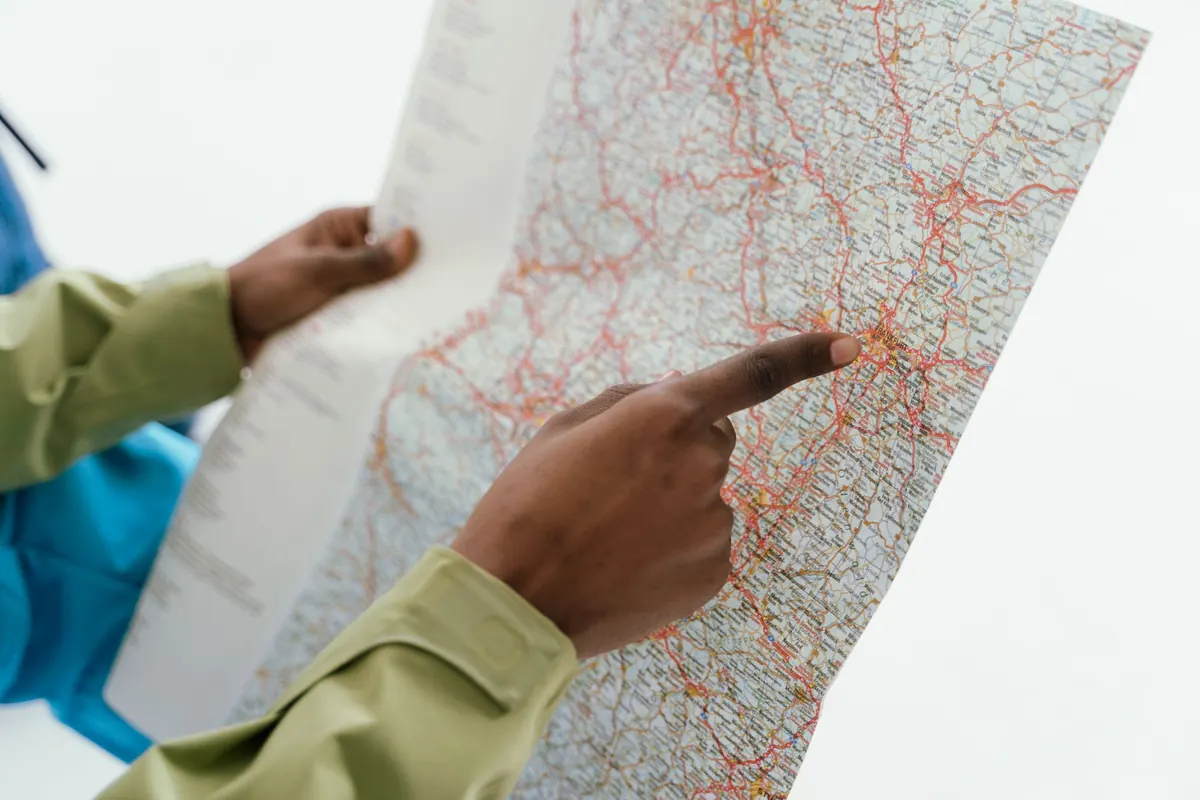
Put every candidate stop on the map at once and look for clumps. A cathedral, a river path, and a good coffee roaster within a few streets of each other are a morning. The sculpture museum across the river is not part of that morning, no matter how quick the metro looks on a screen.
If two stops are not within roughly fifteen minutes of walking, they belong to different halves of the day. This one rule does most of the work. It kills the detours that look harmless on a map and eat forty minutes of a short afternoon.
Inside each cluster, rank what you find: must-see, would-like, and if-there's-time. Give each cluster exactly one must-see. The rest become flexible, which is useful later when a market turns out to be more interesting than the church you planned around.
The line between two pins on a map is a pleasant fiction. Streets bend, rivers get in the way, hills happen, and pedestrian crossings are rarely where you would like them. Always ask for walking distance and walking time, then add a little.
A realistic pace for a visitor is around four kilometres an hour, not five, and that is before shop windows, photo stops, and the small confusion of figuring out which of three similar streets you are standing on. On flat ground with no dawdling, one kilometre takes twelve to fifteen minutes.
These are the things that quietly add time to a leg:
If your route is a loop, check that it comes back. A route that ends three kilometres from your starting point is fine only if there is a tram, a bus, or a pleasant walk home you have already accounted for.
Buffer is not padding for the disorganised. It is the part of the plan that absorbs reality: the exhibition that takes longer than expected, the lunch that turns into two hours, the street that turns out to be worth a detour.
Add about a quarter to a third on top of your summed walking and visiting time. If your estimates add up to five hours, plan a day that comfortably fills six and a half.
Three stops, two legs of fifteen minutes, a forty-minute visit, a forty-five-minute lunch, and a twenty-minute walk to the station. That is four hours of activity in theory. Give it five, and you will arrive at the station calm rather than running.
Then protect one slot. Leave an hour of the day entirely unassigned — no stop, no reservation, no expectation. Most memorable city days happen in that hour, and without it, nothing has room to go right.
Number your pins in the order you plan to visit them and draw the line between them. Then inspect the line rather than the pins. Does it double back on itself? Does it cross a river with no bridge? Does it pass the same square three times?
A few ordering habits help:
Then annotate the map with the unglamorous things: toilets, water fountains, a park bench, a supermarket, the right exit from the metro station. Ten minutes of this saves an hour of wandering.
The night before, run a quick sanity check on opening hours, closing days, and whether any stop needs a booking. Look for market days that might clog a street, or a public holiday that shuts the very place you built the morning around. Check the weather and decide now which stop you would drop if it pours.
Make the route work without a signal. Download the offline map of the area, screenshot the route, and write the four stop names and their neighbourhood on a scrap of paper. If your phone dies at three in the afternoon, that scrap is worth more than any app.
If planning feels like a chore, do the short form: choose two anchors, pick three stops between them, check the walking time for each leg, add a third again, and write the names down in order. That is enough structure to keep the day moving without turning it into a schedule.
Then walk it, and be willing to abandon the plan at the second stop if the city offers something better. The map is a safety net, not a contract. Draw it carefully, fold it up, and spend the rest of the day looking at the streets instead of the screen.
Photo: 14398 / Pixabay